2026 Bilinski Foundation Fellowship Recipients
Ezekiel Acosta

Ezekiel Acosta (he/el) is a PhD Candidate in American Studies at the University of New Mexico. His written work has been featured in Trans Studies Quarterly, LatinxTalk, North American Congress on Latin America (NACLA), and the Southwest Contemporary. He has forthcoming articles within the College Art Association (CAA), Hemisphere: Visual Cultures of the Americas, and within the anthology, Visionary Tactical Lives: Queer and Trans Migrants Making Futures. His writing and research commitments intersect within Central American Studies, Trans Studies, and Archival Studies. His dissertation is entitled, Snapshots of Illegibility: U.S. Funded Police Photography and the Queer Guatemalan Portraits that Proceed Them, which uses archival research and visual productions to better understand the experiences of the LGBTI community during Guatemala’s civil war specifically within the years of 1960-1990. Ezekiel is of Guatemalan, Mexican, and Puerto Rican descent and will be the first in his family to receive a Ph.D. His hope is that Snapshots of Illegibility will one day become a published book.
Gina Binavidez
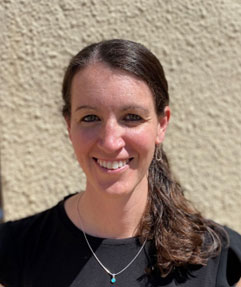
Gina is a PhD Candidate at UNM’s Department of History with an emphasis on Modern Europe, a concentration in Modern Spain, and a certification in Women, Gender, and Sexuality Studies. Her dissertation focuses on the gendered experience of the American female medical volunteers in the Spanish Civil War (1936-1939). This research, while filling the historiographical gap in Spanish Civil War history, also contributes towards the cross-examination of American women’s radical activist history, transnational antifascist women’s history, and American women’s nursing history through the lenses of race, gender, and religion .
Emily Heimerman
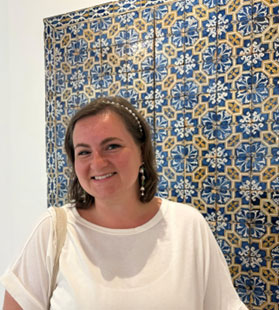
Emily Heimerman is a PhD candidate in the Department of History. Emily's dissertation examines the Second Plague Pandemic – commonly known as the Black Death – through the lenses of historical trauma and the history of emotions. By centering four Iberian and Italian case studies spanning 1347 to 1527, her dissertation explores how survivors understood disease and how religious belief shaped communal and individual responses to mass death. By situating plague within an emotional lens, her work also demonstrates that plague not only reshaped Iberian and Italian societies physically and institutionally but also impacted the emotional communities that shaped late-medieval culture, memory, and religiosity. Emily received her BA in History from the University of St. Thomas and MA in History from Villanova University.
Matteo MacDermant
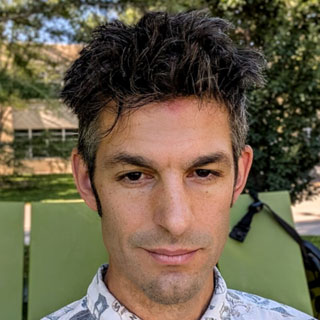
Matteo Rossi MacDermant is a PhD candidate in American Studies at UNM. His dissertation examines the Tech Workers Movement — the wave of organizing that emerged within the tech industry when engineers, designers, and data workers began refusing to build surveillance tools, military technologies, and systems that harm marginalized communities. Drawing on archival research, ethnography, and speculative methods, Matteo argues that this movement represents the most significant organized force for democratic technological transformation today, and that transforming technology requires transforming the labor that produces it. His work bridges the philosophy of technology, labor history, and utopian studies to make the case for a more just and democratic technological future.
Érick Pineda

Érick Pineda is a Ph.D. Candidate in Hispanic Linguistics in the Department of Spanish & Portuguese at UNM. His field of study addresses language contact, sociolinguistic variation, and morphosyntactic change. His dissertation interrogates the interaction between Spanish and P’urhépecha in Michoacán, Mexico, focusing on the variation and usage of grammatical structures such as "estar + gerund" or the present perfect. Érick’s project approaches these linguistic phenomena and morphosyntactic variations through the analysis of empirical data and interviews conducted with bilingual speakers.
Nils Seiler
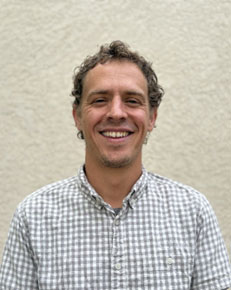
Nils Seiler is a PhD candidate in the Department of Philosophy at UNM. He specializes in South Asian philosophy and is interested in contemporary epistemology. In his dissertation, Reasons & Knowledge: The Sources of Knowledge in South Asian Philosophy, he examines the connection between South Asian epistemological thinking and dialectical texts and practices from the 1 st to 6 th century CE. He argues that problems in epistemology during this period should be understood alongside the topic of inferential reasons and their role in argument. Nils received a BA in Religious Studies from UNM, a MA in Asian Studies from Cornell University, and a MFA in Literary Translation from University of Iowa.
Shebati Sengupta
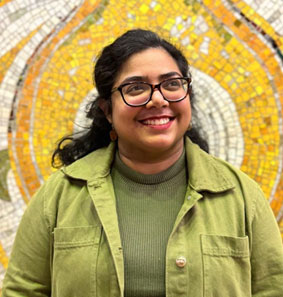
Shebati Sengupta is a PhD Candidate in American Studies, with certificates in Graduate Teaching and Women, Gender, and Sexuality Studies. Their research interests include speculative futurisms, medical humanities, and queer of color poetics. Her dissertation looks at the initial years of the COVID-19 pandemic to theorize how performances of US state sovereignty relate to the embodied horizons of Asian American populations. Through a diverse archive of oral histories, visual art campaigns, legislative documents, and literature, Shebati considers how affective and sociopolitical ideas around immunity, bodies, virulence, and space-time impacted interpersonal and collective actions during the early pandemic period. Their research contributes to questions around how colonial ideas condition the body, and how communities can work towards change under catastrophic circumstances.
Angela M. Stevenson

Angela M. Stevenson is a PhD candidate in the Department of History. Her research focuses on Civil War memory, gender, race, conservatism, and national identity. Angela’s dissertation examines women’s role in propagating the Lost Cause narrative beyond the South and investigates how this evolving memory shaped broader understandings of race, gender, and national belonging in the multicultural Southwest. She holds BA degrees in History and Anthropology with a minor in Religious Studies (New Mexico State University, 2015), a Master of Education (Eastern New Mexico University, 2017), and a MA in History (New Mexico State University, 2022).
Natalia M. Toscano
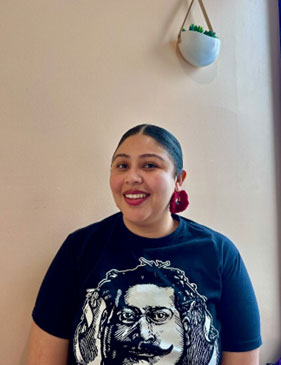
Natalia M. Toscano (she/ ella) is a doctoral candidate in Chicana/o/x studies. She is a scholar researching the intersections of social movements, transnationalism, and political imagination. Her dissertation traces the history of exchange between Chicana/o/x communities and the Ejerecito Zapatista de Liberación Nacional (EZLN or Zapatista)—an Indigenous rebel organization from the highlands of Chiapas, Mexico. By analyzing community archives and oral histories of Chicana/o/x organizers, writers, and artists, Natalia’s dissertation examines the strategies of accompaniment used by Chicanx and Zapatista communities to critique the global neoliberal turn and build pluriversal and dignified lives. Broadly, her research theorizes Chicanx political imaginations rooted in anti-capitalist and decolonial horizons.
Currently, Natalia serves as Co-Editor-in-Chief for Regeneración: A Xicanacimiento Studies Journal. Additionally, her scholarship has been supported by the UNM Center for Regional Studies and the Ford foundation.